
The Role of Casters in Modern Warehousing
Warehouses and distribution centers move more goods faster than ever, driven by e-commerce growth and stricter service-level agreements. Behind every efficient picking line, consolidation area and loading dock is a fleet of trolleys, carts and platforms whose casters determine how smoothly the whole operation runs. A caster failure in a warehouse is not a small annoyance; it stops a picking operation, delays a shipment and adds cost. Understanding caster specification is therefore core logistics knowledge, not an afterthought.
Picking Carts and Order Consolidation Trolleys
Picking carts and consolidation trolleys are the workhorses of every distribution center. They move constantly, turn in tight aisles and carry widely varying loads throughout the day. For this duty, casters need smooth rolling to reduce operator effort, durable wheels that resist wear from continuous use and reliable brakes so carts stay put at pick locations. A common configuration is two swivel casters with brakes at the front and two rigid casters at the back, which gives operators directional stability while keeping the cart easy to steer.
AGV Platforms and Automated Material Handling
Automated guided vehicles are becoming a standard fixture in modern logistics. AGV caster wheels are evolving from generic designs toward purpose-built solutions, as suppliers develop components tailored to automated platforms, with load capacities engineered for continuous robotic duty. The market for AGV-specific caster wheels is growing rapidly worldwide, and buyers increasingly specify dual-wheel and high-capacity designs that deliver the low rolling resistance and precise tracking automated systems require. When a warehouse automates, the caster specification changes with it.
Dock and Loading Equipment
Dock equipment operates at the boundary between warehouse and transport, where floors are uneven and conditions are harsher. Dock plates, yard ramps and transfer carts need casters with higher safety factors and impact resistance. For equipment that crosses dock plates, a safety factor of 1.35 is recommended, and wheels with resilient treads such as PU reduce the shock of transitions. Braking is equally important at the dock, where a moving cart can cause serious injury if not properly controlled.
Specifying Casters for Logistics Environments
Load Capacity and Distribution
The N-1 method applies directly to logistics equipment. Divide the total loaded weight by the number of casters minus one, then apply a safety factor appropriate to the environment: 1.25 for indoor concrete, 1.5 for towed trains of carts. A picking cart with four casters and a 400 kg total load, for example, needs each caster rated for at least 167 kg with a 1.25 factor. Calculating this way prevents premature failure and protects both equipment and staff.
Floor Compatibility and Noise Control
Warehouse floors are typically concrete, but they are rarely perfectly smooth. Epoxy-coated floors, anti-fatigue mats and dock transitions all interact differently with wheel materials. Polyurethane wheels protect finished floors and roll quietly, making them popular for modern distribution centers. TPR wheels add further noise reduction, which matters in facilities where staff work close together all day. Hard wheels such as nylon and cast iron, while strong, mark floors and generate noise; they suit heavy-load, smooth-concrete applications where these trade-offs are acceptable.
Swivel, Rigid and Brake Configurations
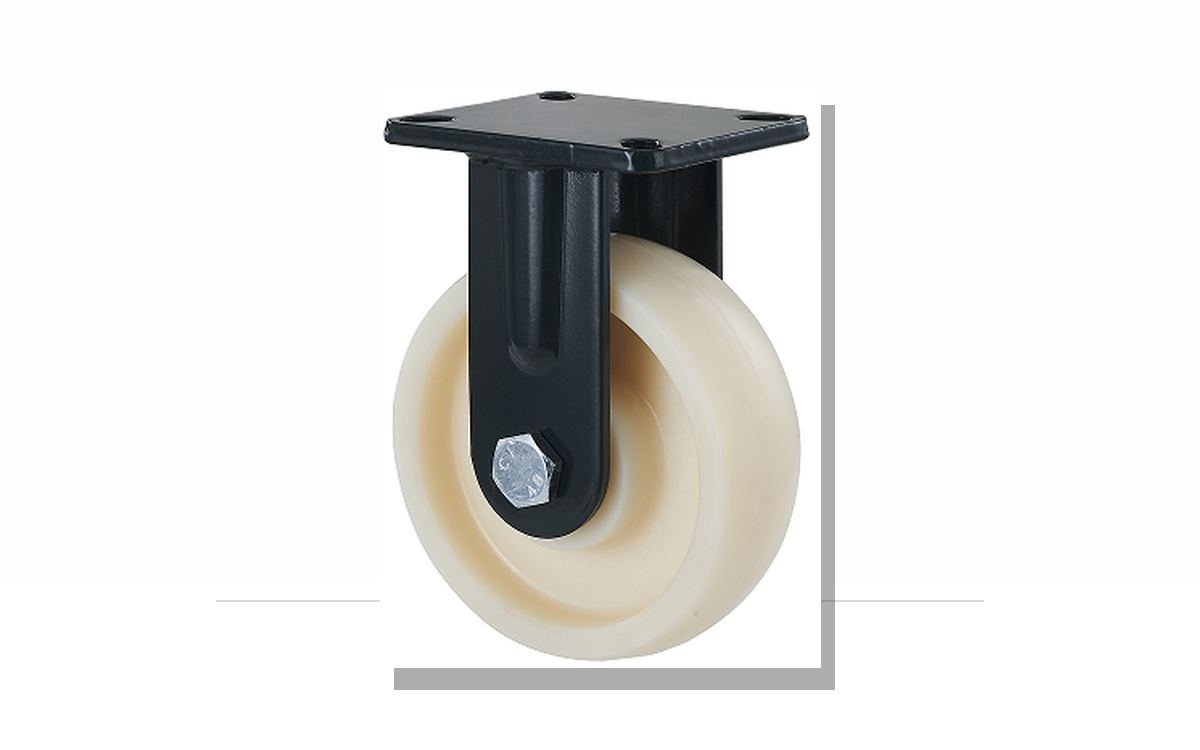
Configuration is as important as capacity. Swivel casters provide maneuverability; rigid casters provide tracking. Brakes should be selected by function: side-lock brakes stop wheel rotation only, while total-lock brakes stop rotation and swivel together. For picking carts that stop frequently, a total-lock brake on the front swivel casters is the most practical choice. For AGV platforms, the specification may require specific mounting heights and twin-wheel designs to fit the vehicle frame.
Why SyncCasters for Logistics Applications
SyncCasters builds caster ranges matched to logistics duty, from medium-duty trolley wheels to heavy and extra-heavy models for AGV platforms, dock equipment and industrial carts. With steel brackets, tested bearings, PU and steel-core wheels and reliable braking systems, our casters are specified for continuous operation in demanding warehouse environments. OEM and ODM support means brackets, wheels, brakes and branding can be tailored to your fleet. Contact us with your equipment weight, floor type and duty cycle, and we will help you specify casters that keep your logistics moving faster and safer.








