
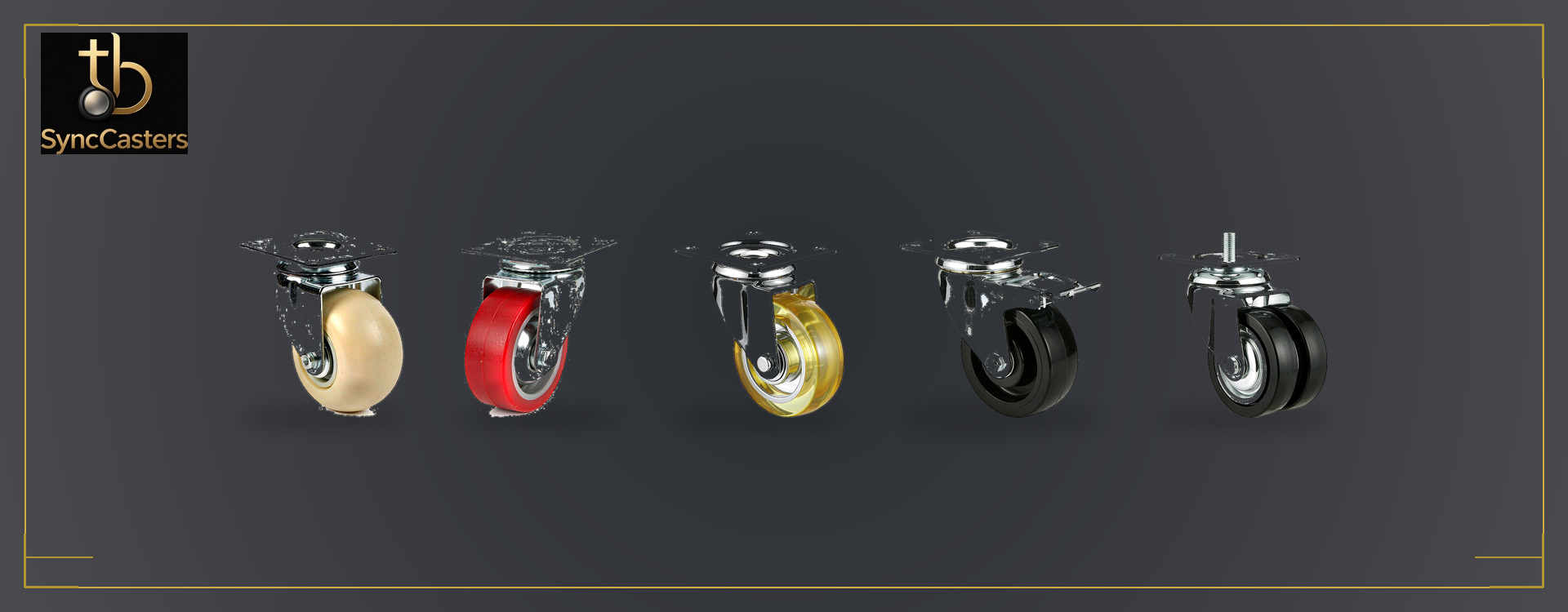
Explore the SyncCasters product range — a complete line of industrial casters engineered in our Zhongshan factory for furniture, material handling, medical equipment and automated machinery. Our catalog is organized into four load tiers — Light, Medium, Heavy and Extra-Heavy — built on shared bracket engineering, a choice of wheel materials, swivel or rigid constructions, and flexible brake and mounting options, so buyers can match a rated load, a floor type and an operating environment to the right caster family without over-engineering the cart.
Light duty casters cover smooth indoor applications such as display stands, point-of-sale fixtures, small trolleys and office furniture, with compact top-plate or stem mounts and soft TPR or nylon treads that roll quietly and protect finished floors. Medium duty casters are the workhorse of everyday industrial and commercial mobility — warehouse picking carts, linen trolleys, mobile kiosks and machinery bases — in nylon, PP or polyurethane wheels with wheel or total-lock brakes. Heavy duty casters carry material handling carts, storage racking, textile machinery and assembly line equipment with steel-core wheels and reinforced brackets, while Extra-Heavy duty casters handle 0.6T to 3.5T loads with twin-wheel and forged-steel designs for the most demanding industrial environments.
Every series shares the same design discipline — controlled steel forming, reliable swivel bearings, tested brake function and clear specification tables — but scales the bracket section, axle size and bearing arrangement to the load it is expected to carry. Beyond standard catalog items, our Zhongshan factory supports OEM/ODM customization: custom top plates, stem types, wheel materials, colors, branding and packaging for buyers who need something the catalog does not yet list. Contact our sales team for load testing, samples and lead times.
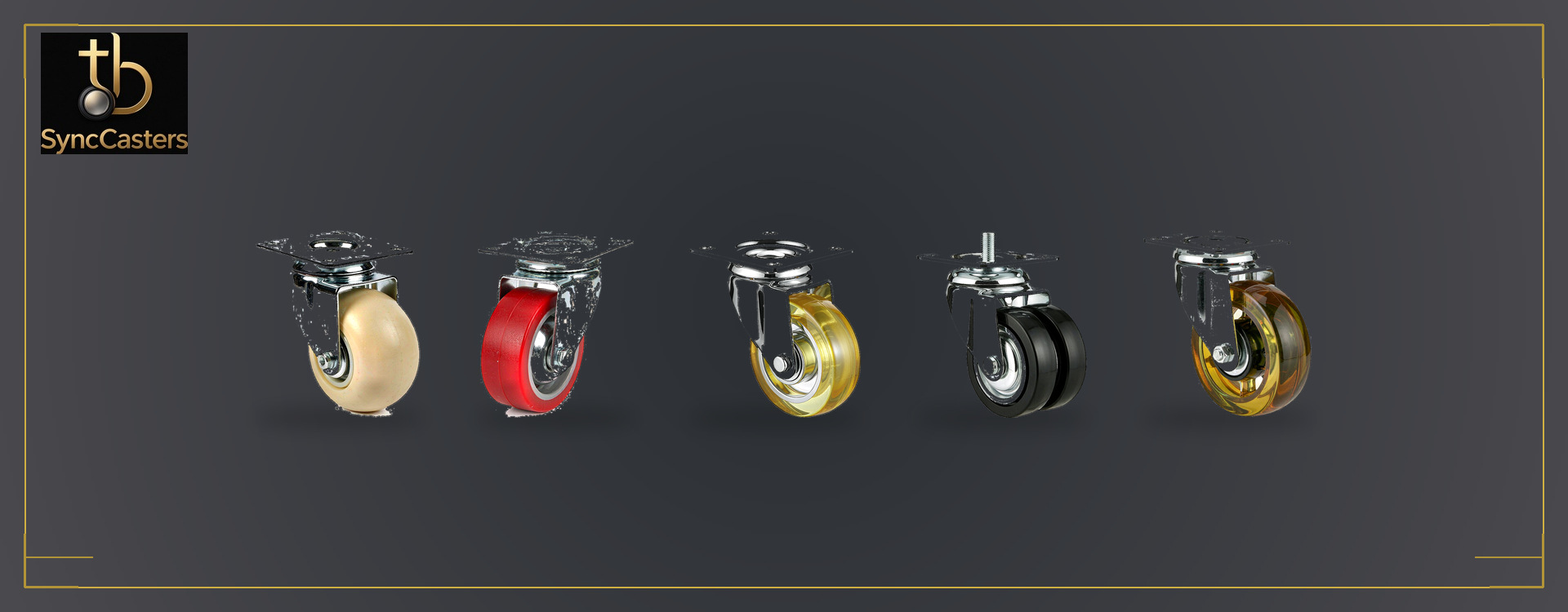
Light duty casters in 2 in - 3 in sizes for furniture, trolleys, display racks and household applications. Smooth-rolling nylon, PP and TPR wheels with durable steel brackets.
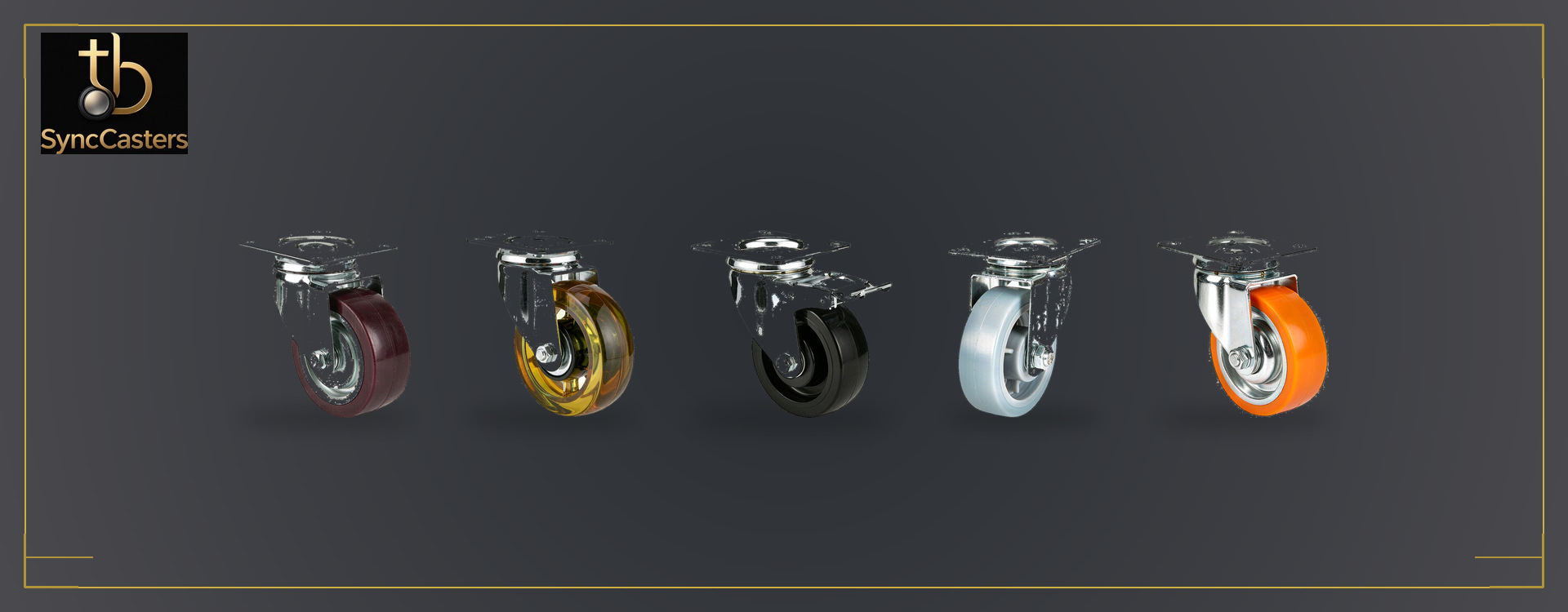
Medium duty casters in 3 in - 5 in sizes for carts, workbenches, racks and light industrial equipment. Strong steel brackets with nylon, PVC, TPR and PU wheels.
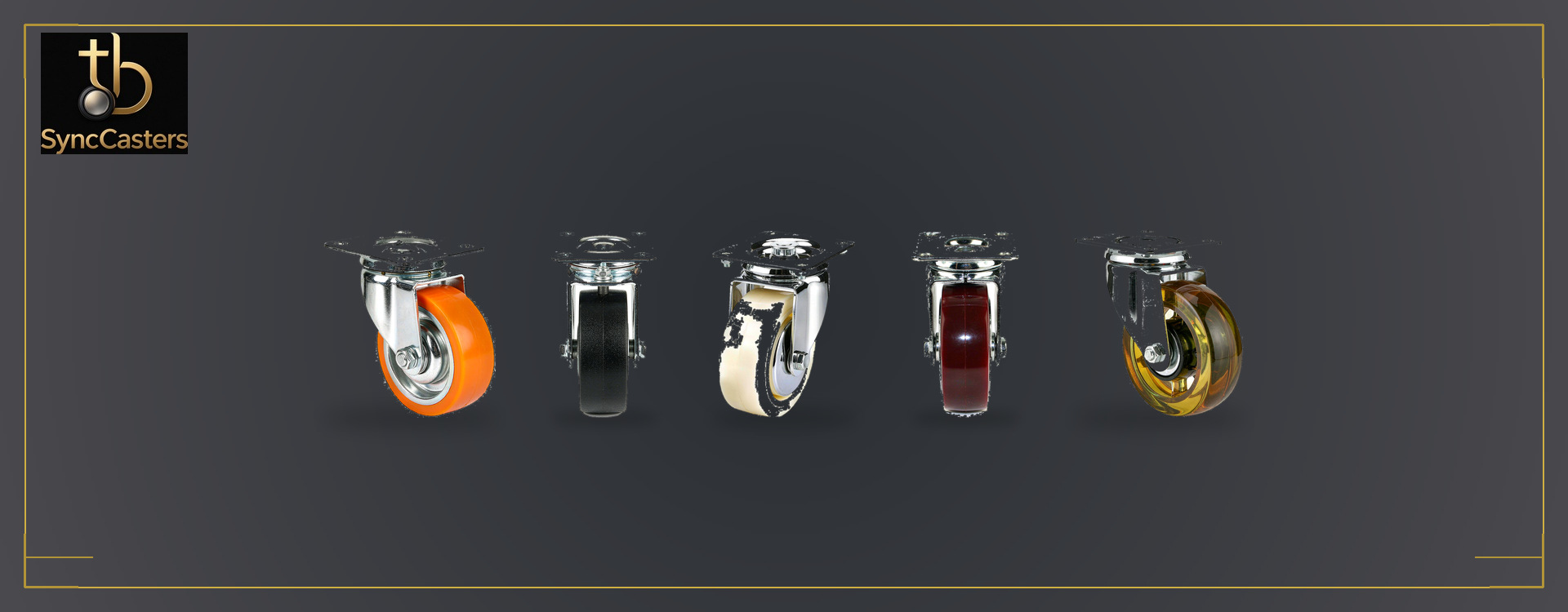
Heavy duty casters with steel core, PP, TPR and PU wheels in 4 in - 8 in sizes for industrial machinery, racks, trailers and heavy equipment. High load capacity with durable construction.
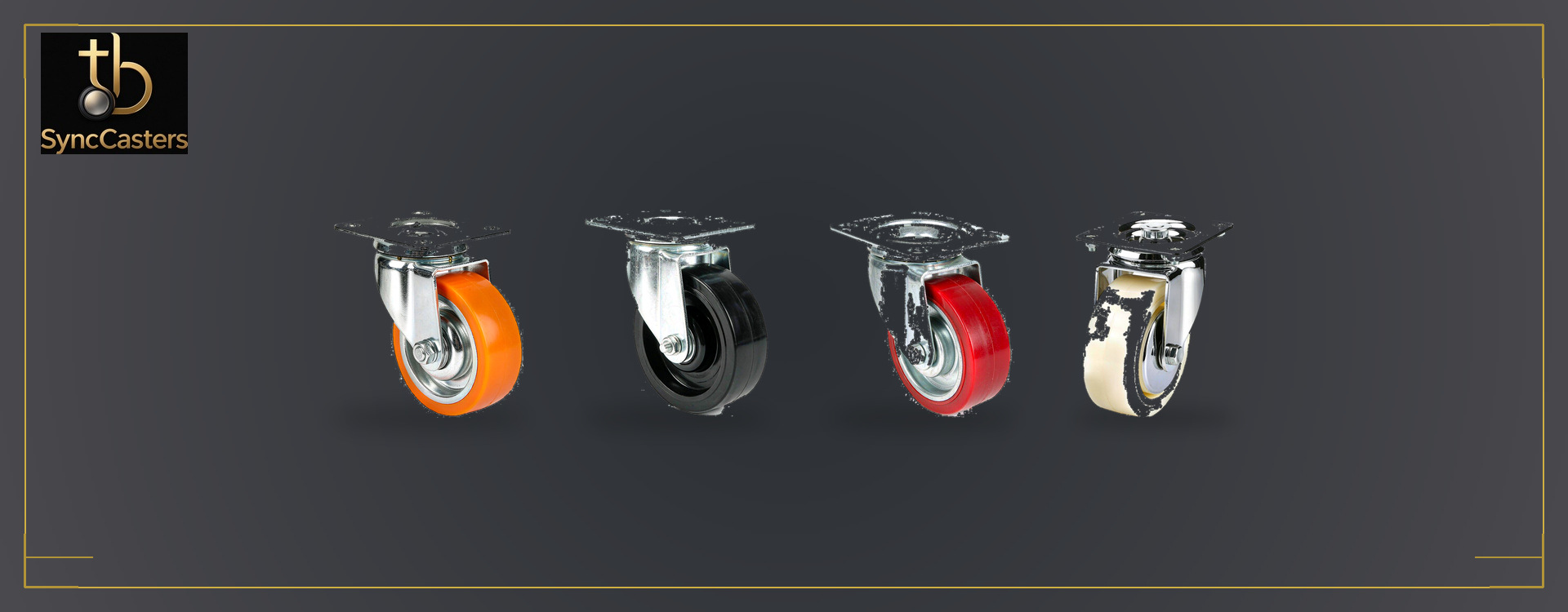
Extra heavy duty casters with twin wheel nylon, steel core PU and full steel wheels for the most demanding industrial applications. Maximum load capacity and durability.
Four Caster Series for Every Load and Floor
SyncCasters products are grouped into four series by rated load, because the most common caster mistake is picking a wheel that looks right but is too light for the job. Each series shares the same design discipline — controlled steel forming, reliable swivel bearings, tested brake function and clear specification tables — but scales the bracket section, axle size and bearing arrangement to the load it is expected to carry. Moving up a series is usually the correct answer when an application feels heavy, noisy or unstable rather than pushing a small caster past its limit.
The Light duty series serves equipment that rolls on smooth indoor floors. These casters are found on display stands, point-of-sale fixtures, small trolleys, laundry baskets, light furniture, medical stands and office equipment. They use compact top-plate or stem mounts, smaller wheel diameters, and softer treads such as TPR or nylon that roll quietly and do not mark finished floors. Load ratings are modest, but the bracket is designed to stay rigid and the swivel to stay smooth over thousands of rotations — failure mode here is usually noise and floor marking, not structural collapse.
The Medium duty series steps up to everyday industrial and commercial mobility. These casters carry warehouse picking carts, linen and housekeeping trolleys, workstation cabinets, mobile kiosks, stage and AV equipment, and medium machinery bases. Wheels are typically nylon, PP or polyurethane on steel or plastic cores, with a choice of swivel or rigid brackets and a wheel brake or total-lock brake where the cart needs to stay put. This series is the workhorse of the range: versatile, cost-controlled, and available in the widest combination of mount and brake options.
The Heavy duty series is where our manufacturing focus sits. These casters are engineered for material handling carts, storage racks, containers, tool and die cabinets, automotive assembly fixtures, and equipment frames that move around a plant floor repeatedly. Brackets use pressed or welded steel sections sized for the load, swivel sections use double ball-bearing or tapered-bearing constructions for smooth pivoting under weight, and axles are sized to handle impact and side loads. Wheel choices are dominated by polyurethane on cast iron or aluminum centers for floor protection and long life, plus nylon for the toughest dry environments.
The Extra-Heavy duty series is reserved for loads where a caster failure is not acceptable. These are the casters under machine skids, large generator and transformer enclosures, heavy transport frames, shipboard and offshore-adjacent equipment, large battery and energy storage units, and the kind of carts that move entire workstations around a factory. Brackets are heavily welded, swivel sections use robust tapered or cylindrical bearings, and wheels are typically polyurethane on cast iron, forged steel, or high-capacity cast iron and heat-resistant compounds. Load ratings are stated conservatively and validated by sample testing before production approval.
Across all four series, buyers benefit from a single engineering base. Mounting interfaces, brake pedals, wheel compounds and quality methods are shared, so moving from a Medium cart caster to a Heavy rack caster does not require learning a new supplier. Distributors can stock a coherent range, OEMs can specify the same bracket family across different products, and service teams recognize the components regardless of which series the caster belongs to.
Typical cross-industry applications include: retail and display (Light), hospitality and housekeeping (Light to Medium), warehousing and logistics (Medium to Heavy), automotive and machinery manufacturing (Heavy to Extra-Heavy), food and pharmaceutical processing (Medium to Heavy with appropriate tread and plating), and energy, utilities and heavy equipment (Extra-Heavy). When an application does not fit neatly, our engineering team recommends the series and wheel combination rather than letting a buyer guess from a photograph.
Wheel Materials, Brackets, Brakes and Mounting Options
Every SyncCasters series is configurable around four choices.
Wheel material sets the rolling behavior. Polyurethane (PU) is the default for industrial floors: quiet, floor-friendly, long-wearing and load-stable. Nylon is hard, wear-resistant and dimensionally stable for dry aggressive environments. Polypropylene (PP) is the lighter economy option for smooth floors. TPR gives a soft, non-marking roll at a lower price point than PU. Solid rubber handles rough outdoor and uneven concrete. Cast iron and heat-resistant compounds serve high-temperature and very heavy-duty settings.
Bracket style is the second choice. Swivel casters pivot around a bearing race and are used where steering matters; rigid casters roll in a fixed line and are paired with swivel units for push stability. Under higher loads, swivel construction moves from ball-bearing to tapered-bearing to resist side thrust.
Brakes come in three families: wheel-only brakes that stop rolling, total-lock brakes that stop both wheel and swivel, and directional locks that force straight travel.
Mounting options include top plate, threaded stem, grip-neck stem, and socket or socket-and-pin fittings, each with stated hole patterns and dimensions so the caster bolts or drops straight onto the intended frame.
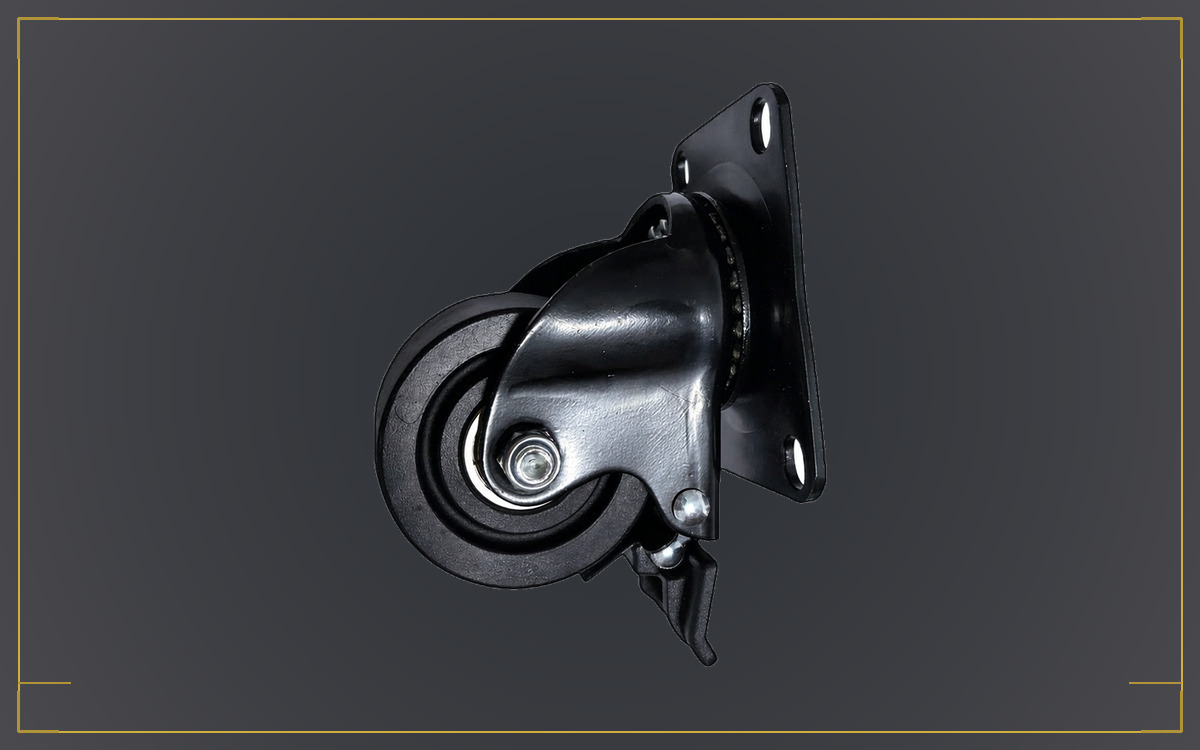
Utility Brake Caster
Utility caster with compact design and reliable brake in 1.5 in – 3 in sizes for platform trucks, dollies and light industrial carts. Durable wheel for safe, smooth handling.
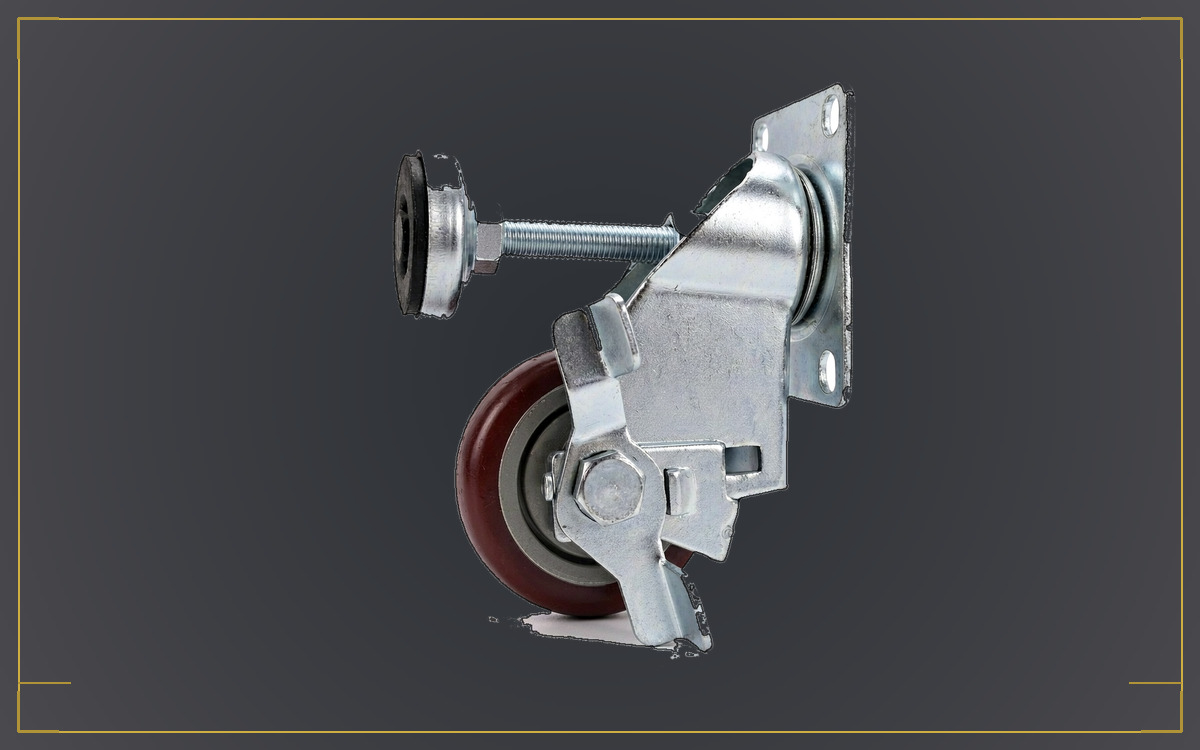
Leveling Caster
Leveling caster with precise height adjustment for machines, display racks and industrial equipment. Sizes 2.5 in – 4 in with sturdy metal construction and easy operation.
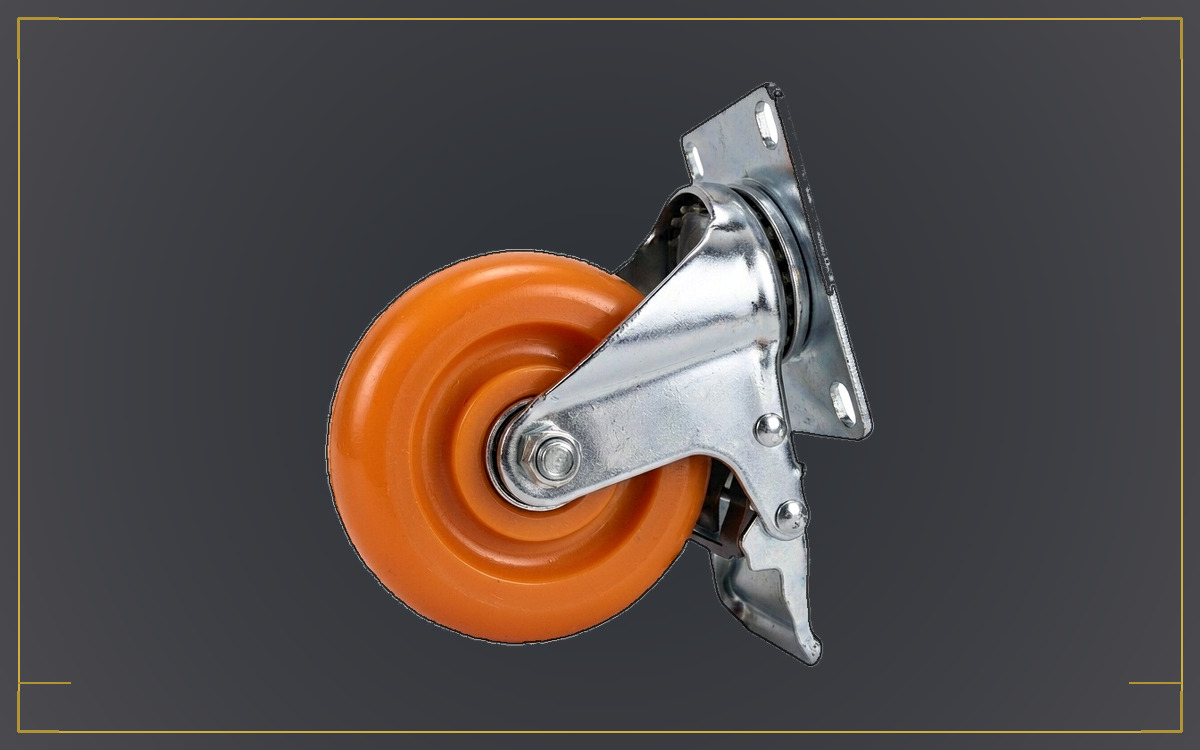
Medium Duty Brake Caster
Medium-duty swivel caster with steel bracket, total-lock brake and heavy-load wheel in 3 in – 5 in sizes for carts, workbenches and light industrial equipment. Strong capacity with stable movement.
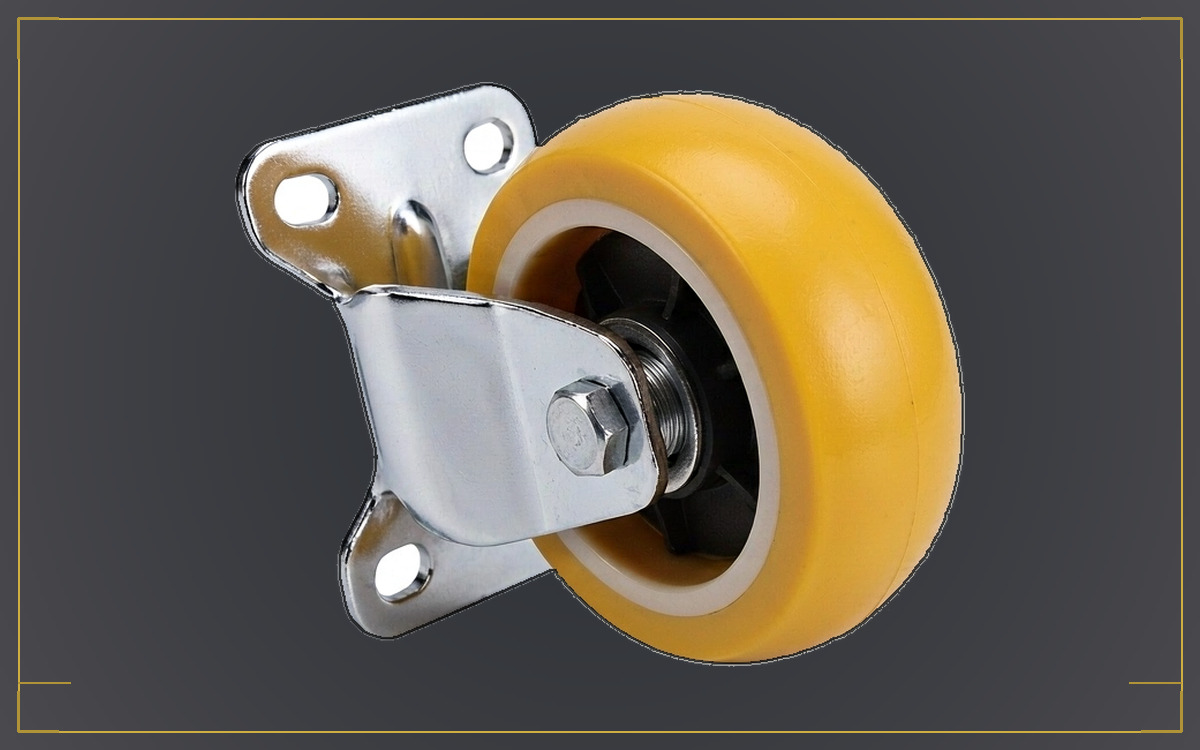
TPR Silent Caster
TPR silent caster with quiet thermoplastic rubber wheel in 2.5 in – 3 in sizes for furniture, medical equipment and trolleys. Low noise, floor-friendly and shock absorbing.
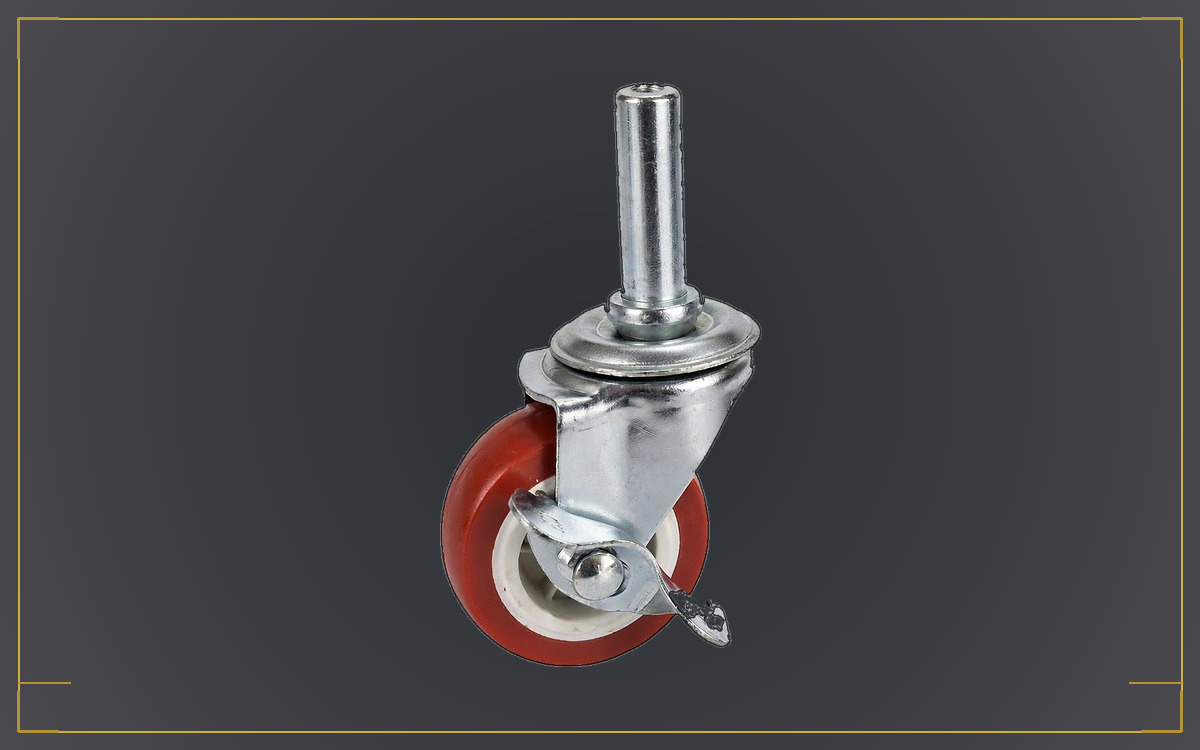
PP Wheel Caster
Light-duty caster with durable polypropylene wheel in 2 in – 3 in sizes for trolleys, display racks and light furniture. Corrosion-resistant, easy-rolling and cost-effective.
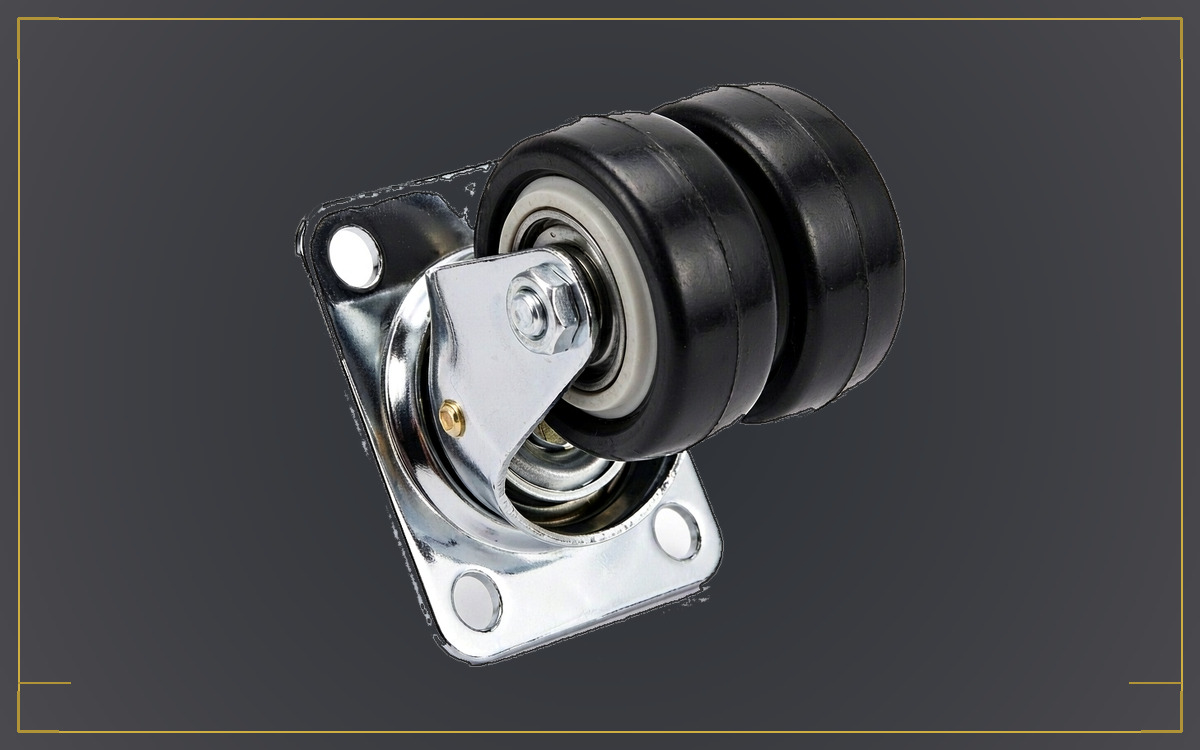
Diamond Series Caster
Diamond series swivel caster with chrome-plated steel bracket and premium wheels in 2 in – 3 in sizes. Smooth rolling, low noise and long service life for furniture, trolleys and light-duty applications.
How to Select the Right Caster — and How We Customize It
Selecting the right caster is a process, not a product search. Four questions narrow the range faster than browsing photographs: the load per caster, the floor surface, the operating environment, and the braking and positioning behavior required. Run through them in order and the catalog does the rest.
Load per caster is the first filter. Divide the total moving weight by the number of casters and apply a safety margin — a caster rated exactly to the calculated load is a caster living at its limit. When four casters support a frame, only three may carry the load at once on an uneven floor, which is why conservative buyers step up one series rather than down. The Heavy and Extra-Heavy brackets are engineered with that margin in mind, and the ratings in the specification table are the tested numbers, not rounded marketing figures.
The floor determines the wheel material. Hard epoxy, polished concrete and tile floors want polyurethane or TPR that will not mark and will roll quietly. Rough outdoor concrete, cobblestone and unfinished plant floors suit rubber or nylon that survives debris. Elevated-temperature environments, foundry floors and oven-adjacent equipment need heat-resistant wheels rather than standard PU, which softens. Clean and food environments favor non-marking, easy-to-clean treads and corrosion-resistant plating. Choosing the tread for the floor prevents the two most common field complaints: marks on the floor and a wheel that wears out in months.
The environment and the duty cycle set the rest. A cart that sits still most of the time needs a different brake than one locked and unlocked hundreds of times a shift. Total-lock brakes suit equipment that must stay put on a slope or near moving machinery; wheel-only brakes suit carts that pause briefly and move on; directional locks suit long straight runs where wandering wastes space. Moisture, washdown, coastal salt air and chemical exposure drive the plating and material choices, and we will call out a corrosion-resistant version when the standard finish would not survive.
When the catalog does not match, our factory customizes. OEM partners send the rated load, the mounting interface, the floor and the cosmetic requirement, and our engineering team adapts an existing Heavy or Extra-Heavy platform: modified plate dimensions, custom wheel diameters, special tread compounds, brake choices, and private-label packaging and marking. ODM projects go further: we design the bracket around your product's center of gravity and roll height, prototype it, load-test the samples, and move into serial production once the approval sample passes.
Working with a factory rather than a reseller changes the economics and the accuracy. There is no middle layer guessing which wheel compound you meant, no surprise when a bracket runs out and a substitute appears, and no generic answer when a part needs modification. You talk to the people who formed the steel, welded the bracket and ran the load test. Quotes are based on real tooling and real production flow, and samples reflect the geometry you will receive at mass production rather than a hand-built one-off.
The selection conversation is short. Send the application, the load, the floor, the environment and the target quantity. We reply with a recommended series, a wheel and brake choice, a sample plan and a production estimate. If the application is near a bracket's limit, we recommend the next size. If it sits outside the catalog, we propose a custom build. The aim is a caster that works in the field, not a caster that merely fits the page.
Buyers are often surprised how much the offset and swivel radius matter once the caster is mounted. A bracket that rolls well on a flat sample table can bind on a cart with a low frame or a narrow footprint, which is why we recommend samples before tooling for new products. A short trial on the actual floor reveals floor marking, noise level, steering effort and brake feel in a way a specification table cannot. For high-volume OEM projects we treat sampling as a required step rather than a courtesy.
What Happens After You Approve a Sample
Once a sample is approved, production moves through a controlled path.
Tooling and fixtures are retained and registered against your part number, so repeat orders build on the same geometry that passed the approval sample. Material suppliers are locked to the agreed specification, and incoming inspection checks each batch against it.
Production follows the same route every time: forming, welding, wheel and axle assembly, brake fitting, visual and dimensional inspection, brake function test, and sample load check on a statistical basis. Batch codes are recorded against the order so that any field question can be traced back to the production run.
Packaging follows your requirement — bulk export packing, retail-boxed private-label, or assembled units ready to mount. Documentation follows the shipment: packing list, batch record, material declaration and test summary where requested.
Repeat orders are re-quickly because the part number, tooling and history already exist. Engineering changes are discussed before they happen, never applied silently. The result is a caster that performs the same on order one, order fifty and order five hundred.








