
Why Heavy Duty Casters Matter on the Factory Floor
In any manufacturing plant, the movement of materials, tools and work-in-progress is as important as the production process itself. Heavy duty casters sit at the center of that movement. They carry machine carts, tool trolleys, assembly fixtures and mobile workstations, and they do it under loads and conditions that ordinary light-duty wheels cannot survive. Choosing the right heavy duty caster is not just a purchasing decision; it is a maintenance, safety and productivity decision that affects every shift.
Handling Loads That Move Constantly
The first difference between a workshop caster and a true heavy duty industrial caster is capacity. Manufacturing equipment is heavy, and it often carries additional loads while moving: a tool cart with a full set of dies, a maintenance platform with spare parts, a line-side rack with a day of components. A heavy duty caster with a properly sized wheel absorbs this weight without deforming the bracket or seizing the bearing. Over-specifying is common and acceptable; under-specifying leads to cracked wheels, bent kingpins and unplanned downtime.
Assembly Line Fixtures and Work-In-Progress Trolleys
Modern assembly lines increasingly use movable stations rather than fixed benches. Work-in-progress trolleys, line-side feeder racks and finished-part carts all rely on casters that roll smoothly on concrete, tolerate frequent direction changes and stay quiet enough not to interfere with communication on the floor. Swivel casters on the leading corners and rigid casters at the trailing corners give a cart predictable tracking. Total-lock brakes keep a station stationary while an operator works on it, which is essential for safety and precision.
Integrating Casters with AGVs and Automated Lines
Automated guided vehicles (AGVs) and autonomous mobile robots (AMRs) are transforming material handling, and their mobility depends on specialized caster systems. Industry sessions such as MODEX 2026 dedicated whole discussions to the relationship between casters and automated vehicle performance, because software, sensors and navigation only work when the wheels underneath perform reliably. For AGV platforms, casters must deliver low rolling resistance, accurate tracking, consistent height and high load capacity at continuous duty. Twin-wheel and motorized caster designs are becoming standard as warehouses and factories push automation deeper into daily operations.
Choosing the Right Heavy Duty Caster for Manufacturing
Load Calculation for Production Equipment
A practical method for calculating required load per caster is the N-1 method: divide the total loaded weight by the number of casters minus one, then apply a safety factor. For indoor concrete floors a safety factor of 1.25 is typical; for dock plates 1.35; for towed equipment 1.5; and for outdoor use 1.75. The N-1 logic accounts for the reality that on uneven floors one caster will lift off the ground, leaving the remaining casters to carry the full load. For equipment with eight or more casters, N-2 is used instead. This calculation is the difference between a caster that lasts years and one that fails in months.
Wheel Material Selection for Factory Floors
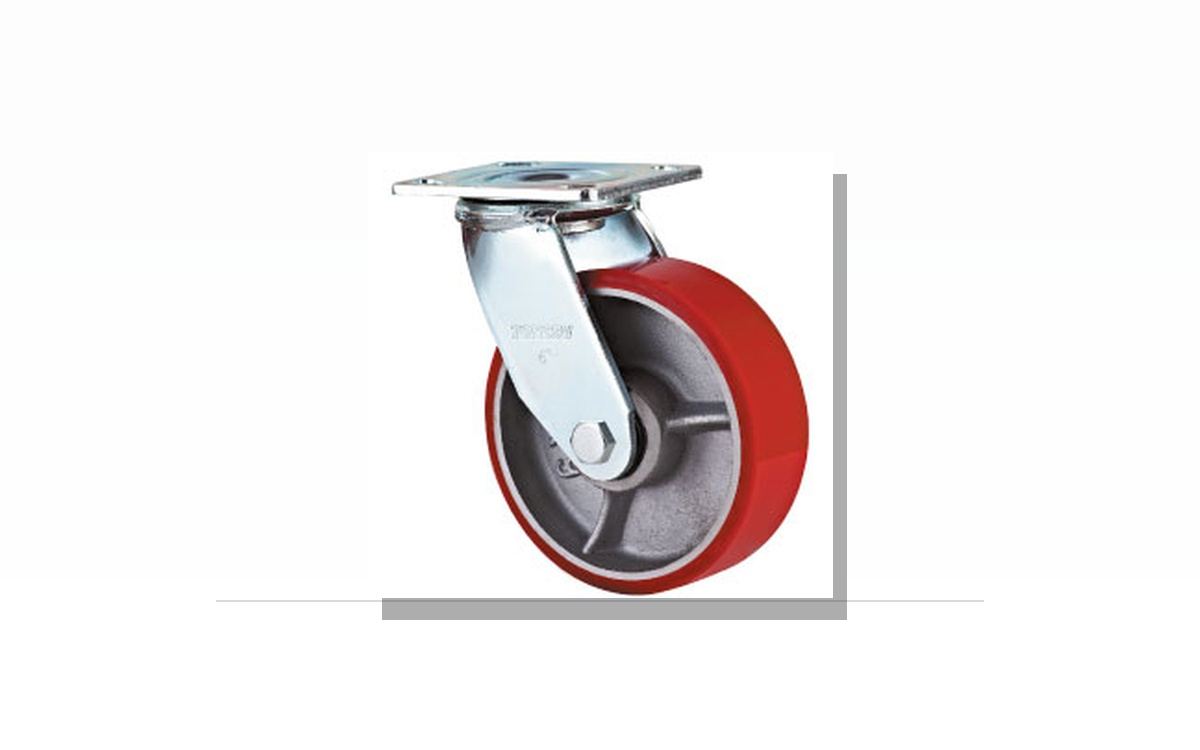
Factory floors vary widely, and the wheel must match them. Steel-core polypropylene (PP) wheels offer an excellent balance of strength and economy for general industrial use. Thermoplastic rubber (TPR) wheels add quietness and shock absorption, which suits production areas where noise matters. Polyurethane (PU) wheels combine high load capacity with excellent floor protection and low rolling resistance, making them the fastest-growing choice in industrial environments. Nylon wheels carry very heavy loads but can mark soft floors. The right material reduces both maintenance cost and operator fatigue.
Brake and Locking Options for Safety
Brakes are not an optional extra in manufacturing. Directional locks keep swivel casters tracking straight, which is critical for carts pushed down long aisles. Total-lock brakes lock both wheel rotation and swivel simultaneously, holding a cart firmly in place while an operator loads or works on it. Brake quality matters: a brake that slips under load is a safety hazard. Choose casters with tested, robust brake mechanisms and verify that the brake type suits how the equipment is actually used.
Working with SyncCasters on Factory-Grade Mobility
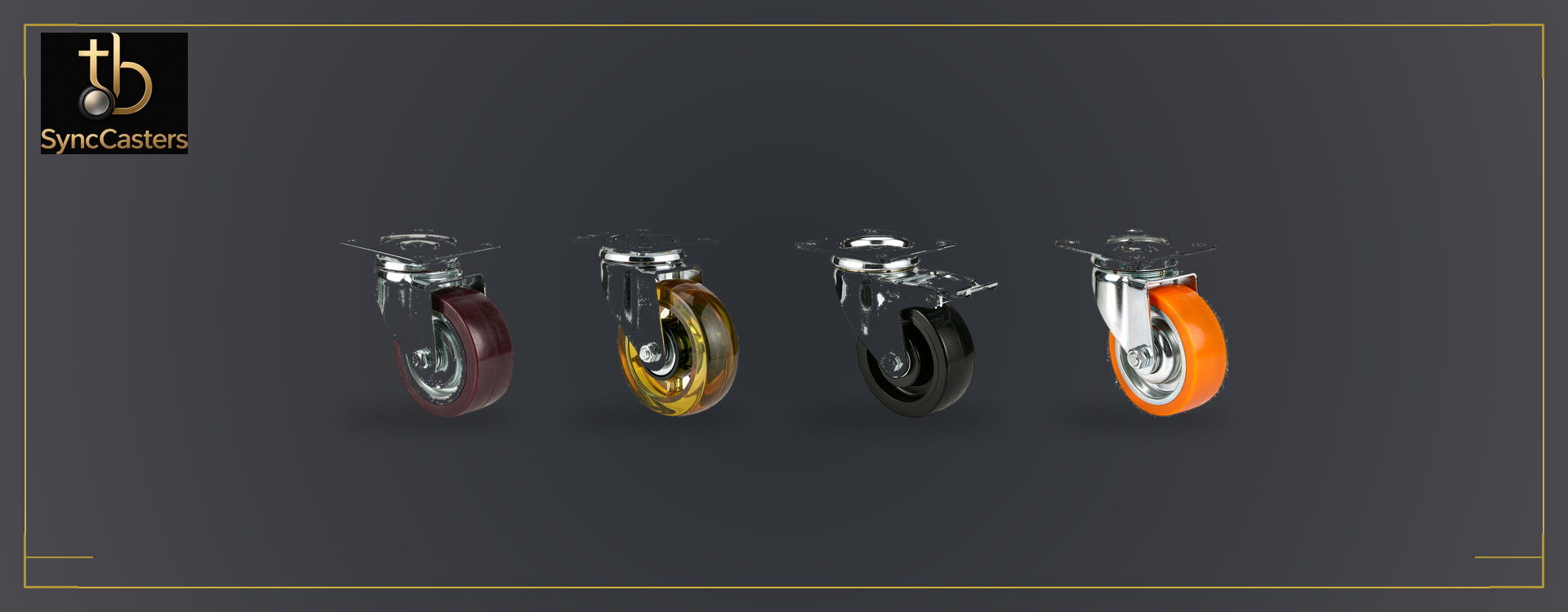
SyncCasters supplies heavy duty caster series designed for manufacturing environments, with steel brackets, tested bearings and a range of wheel materials including steel-core PP, TPR and PU in sizes from 4 to 8 inches. Every model supports OEM and ODM customization, from wheel durometer to bracket finish and brake configuration. When you plan a new line, a fleet of trolleys or an AGV integration, the right specification starts with load calculation and ends with a caster built for continuous duty. Our team helps you match capacity, material and braking to your exact floor and process, so your equipment keeps moving and your production keeps running.








