

Turning Requirements Into a Specification
In Step 2 we do the engineering that most buyers skip. We calculate the load each caster must actually carry, choose the wheel material for your specific floor, and confirm bracket, swivel and brake configuration so the recommendation is robust rather than hopeful. When this step is done well, the caster you receive works the first time and lasts for years.
Load Calculation With a Safety Margin
We use the N-1 method: divide the total loaded weight by the number of casters minus one, then apply a safety factor. This accounts for the real-world fact that on uneven floors one caster periodically lifts off the ground, leaving the others to carry the full load. A typical factor is 1.25 for smooth indoor concrete, rising to 1.35 for dock plates, 1.5 for towed equipment and 1.75 for outdoor use. For platforms with eight or more casters we use the N-2 method instead. The result is a caster rated comfortably above the actual worst-case load, which is what prevents bent brackets and cracked wheels in the field.
Matching the Wheel to the Floor
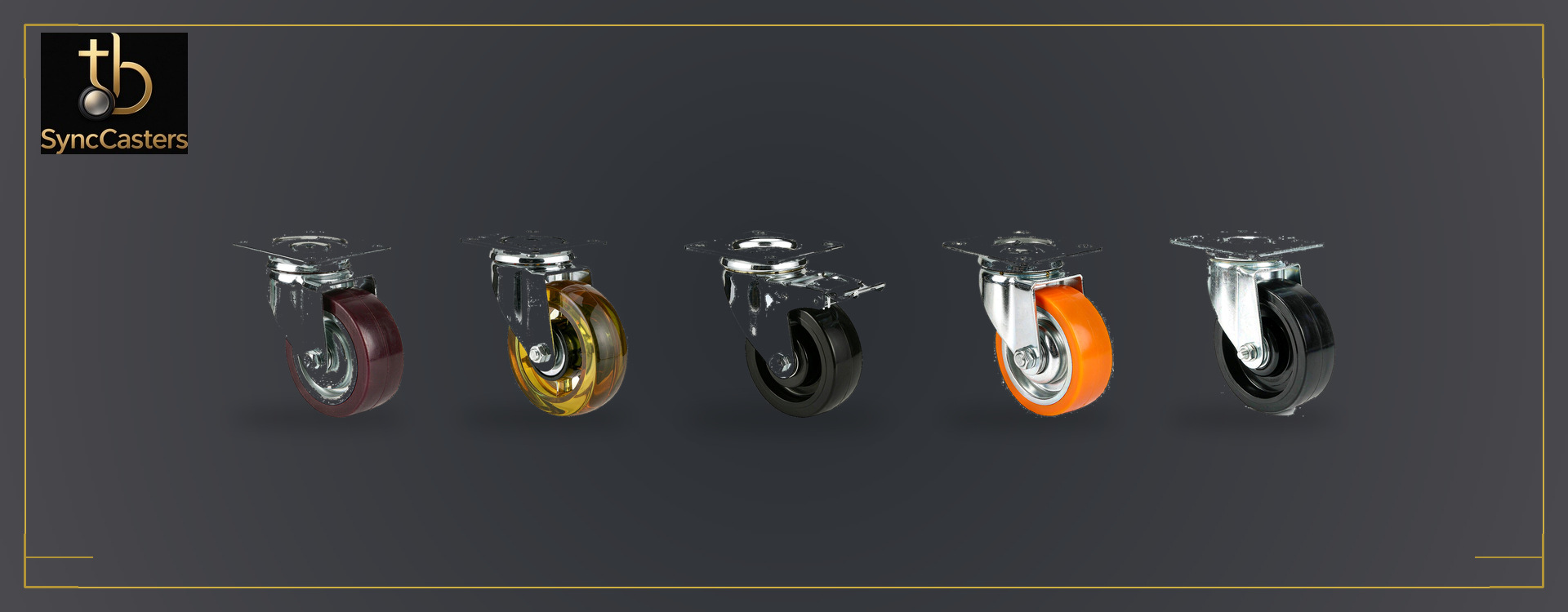
Wheel material decides three things: capacity, floor protection and rolling effort. Polyurethane protects finished floors and rolls quietly, nylon carries heavy loads on smooth concrete, TPR and rubber add cushioning and low noise, and polypropylene resists water and chemicals in washdown areas. We match the material to your actual floor and environment rather than defaulting to the cheapest option. As part of evaluation we also benchmark the designs offered by other manufacturers in the market, so the recommendation reflects what a correct, comparable specification looks like rather than an internal preference.
Bracket, Swivel and Brake
Next we confirm the bracket type, whether each caster swivels or is rigid, and the brake. Swivel casters rotate 360 degrees for maneuverability, while rigid casters track in a straight line, and most carts use swivel at the front and rigid at the rear. Side-lock brakes stop the wheel only, while total-lock brakes stop both wheel and swivel, which matters for equipment that must stay perfectly still during work. We also verify the mounting height and bolt pattern against your frame so the finished equipment stands at the correct working height and the casters bolt on without modification.
A Specification You Can Trust
At the end of technical evaluation you receive a written specification: size, capacity, wheel material, bracket, brake and mounting, with the reasoning behind each choice. This document becomes the reference for sampling and production.
Why Evaluation Prevents Field Failure
Most caster failures trace back to selection, not manufacturing. A caster chosen by price or by guesswork fails under vibration, marks the floor, or rolls when it should hold still. The evaluation step removes that risk before a single part is made, protecting both your equipment budget and your operators' safety. It also avoids the hidden cost of premature replacement and the downtime that comes when a cart or machine is out of service while a new caster is found.
Moving to a Custom Solution or Sample
If the evaluation shows a standard catalogue caster fits your load and floor, we move straight to sampling in Step 4. If your load, size, mounting or environment is unusual, the findings feed into a custom solution in Step 3. In both cases the engineering is documented, so the final product matches what was approved rather than drifting during production. You always know exactly why a caster was specified a certain way.
How SyncCasters Evaluates Your Application
Our team walks buyers through load calculation, material selection and configuration for both OEM and replacement projects. We do not just sell a wheel; we help you work out the right capacity, bracket and brake for your floor, duty cycle and safety needs. Bring us the equipment weight, the number of casters, the floor type and how the machine is used, and we will deliver a specification that performs reliably for years instead of a part chosen by guesswork.
