
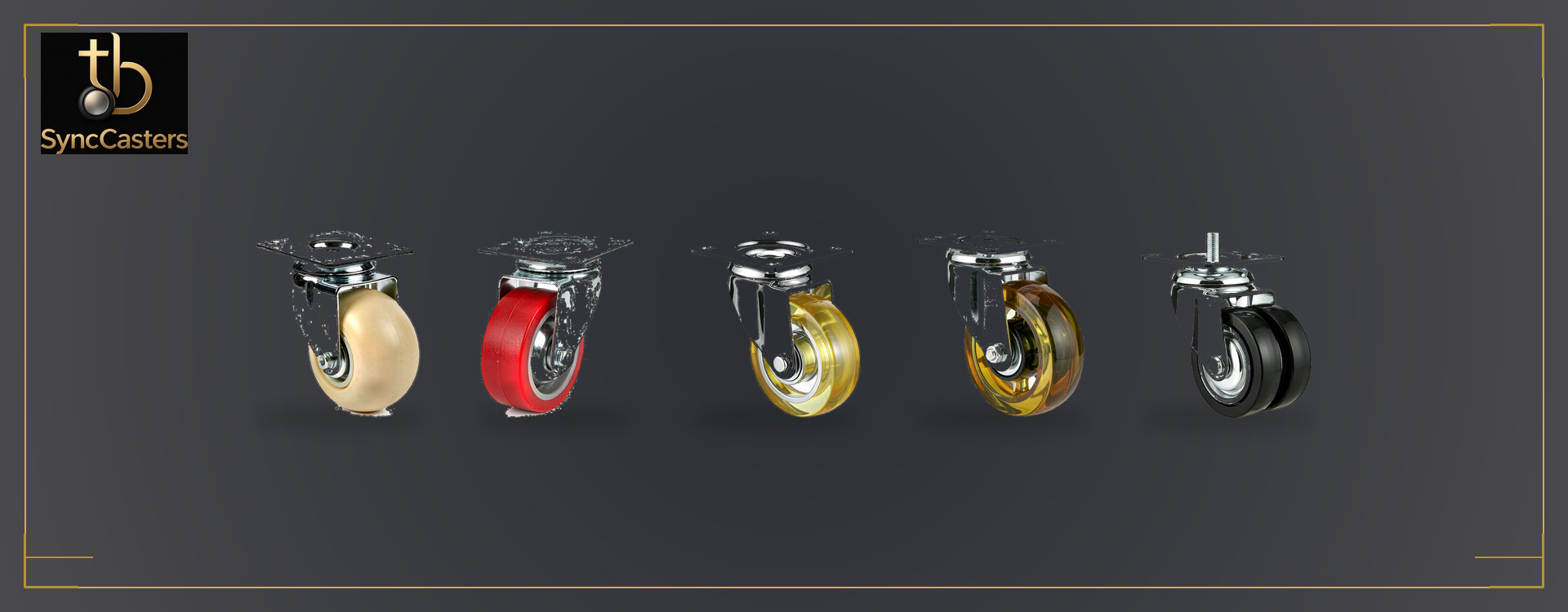
Need the full SyncCasters range in one document? Our product catalog brings together four load tiers, multiple wheel materials, bracket styles, brake options and mounting configurations, along with the specification tables buyers use to shortlist and select the right caster. This page explains what the standard catalog contains, how to request your copy, and how we can prepare a customized catalog tailored to your brand, your market and the applications your customers actually run into on the factory floor.
What Is Inside the SyncCasters Catalog
The SyncCasters catalog is a working reference, not a marketing booklet. It is organized so that a buyer, engineer or distributor can move from application to part number in a few steps: identify the load tier, choose the wheel material for the floor and environment, pick the bracket and brake style, confirm the mounting interface, and cross-check the numbers against the specification table. Every entry shows the data needed to make a purchase decision, rather than a photograph with no dimensions.
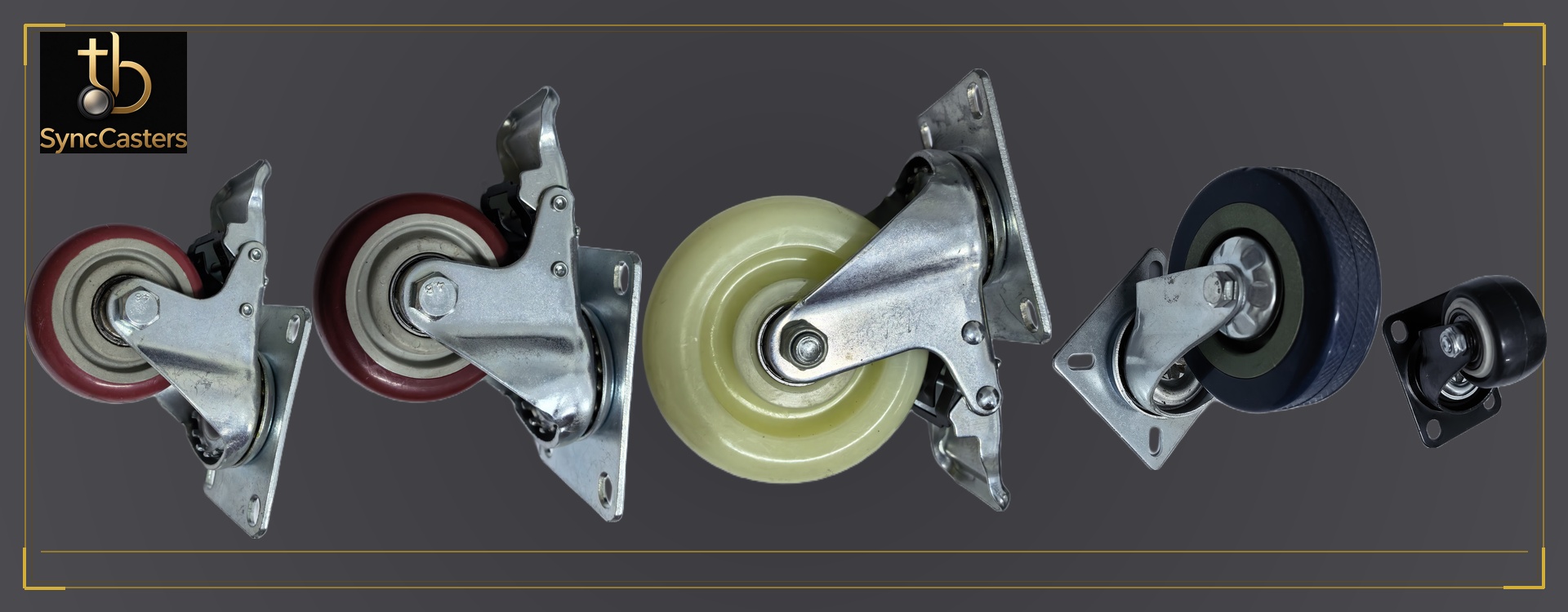
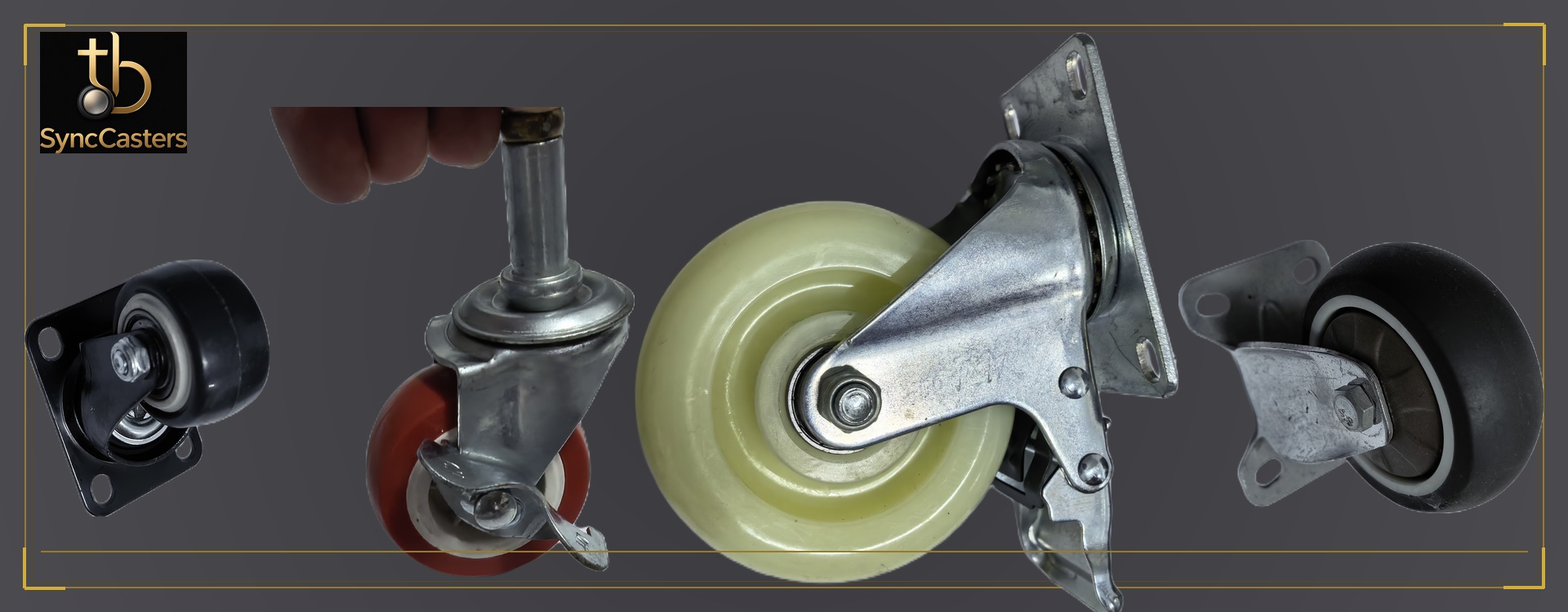
The core of the catalog is our four caster series, grouped by rated load. Light duty casters cover equipment that moves on smooth floors — trolleys, display stands, light carts and office and hospitality furniture. Medium duty casters step up to warehouse carts, laundry and linen trolleys, workstation stands and light machinery bases. Heavy duty casters are built for industrial racks, containers, tool cabinets, automotive assemblies and material handling carts carrying serious weight. Extra-heavy duty casters are reserved for the toughest jobs: machine skids, large enclosures, heavy transport frames, battery and energy storage units, and equipment where a caster failure would mean a safety incident rather than an inconvenience.
Within each series the catalog lists wheel material options matched to floor and environment. Polyurethane (PU) wheels roll quietly and protect epoxy and polished floors while carrying good loads. Nylon and polypropylene (PP) wheels are hard, dimensionally stable and economical for general industrial use. TPR (thermoplastic rubber) gives a softer, floor-friendly roll at lower cost than full PU. Solid rubber wheels suit rough outdoor and industrial floors, while cast iron and heat-resistant wheels serve foundry, oven and high-temperature applications. Each material entry notes typical load behavior, floor protection, noise level and recommended environments.
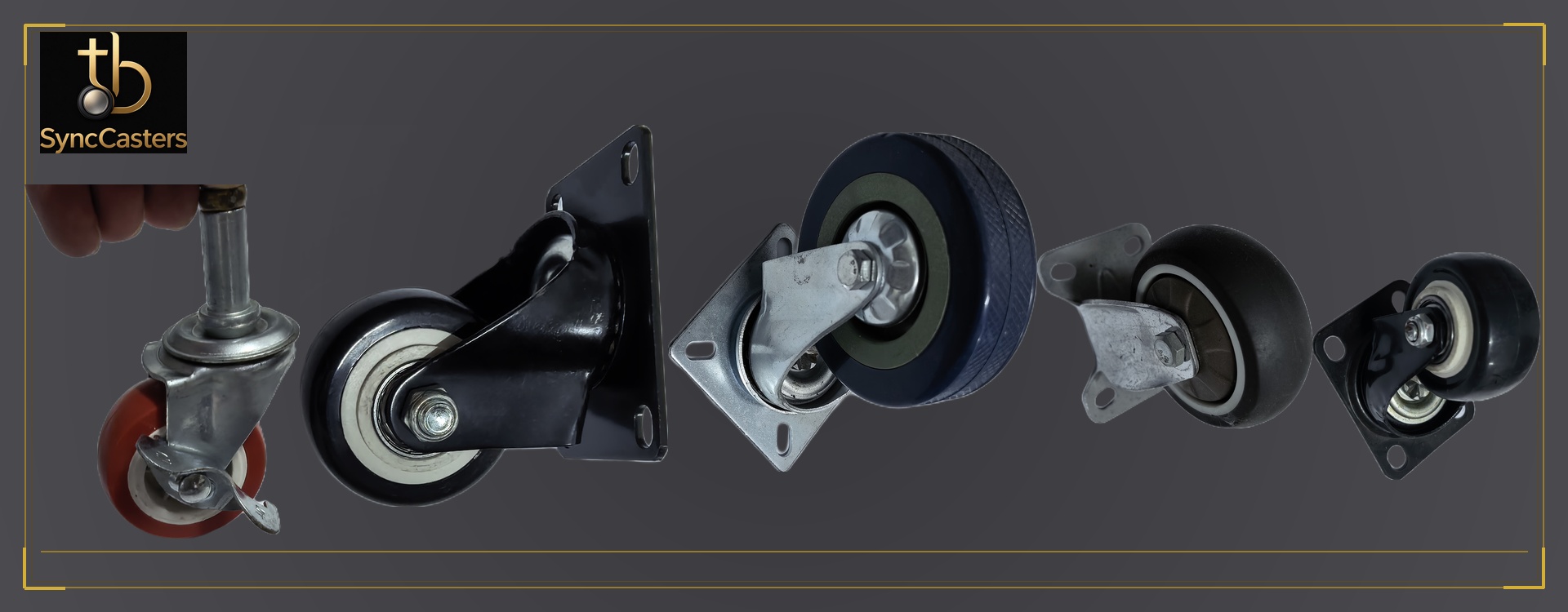
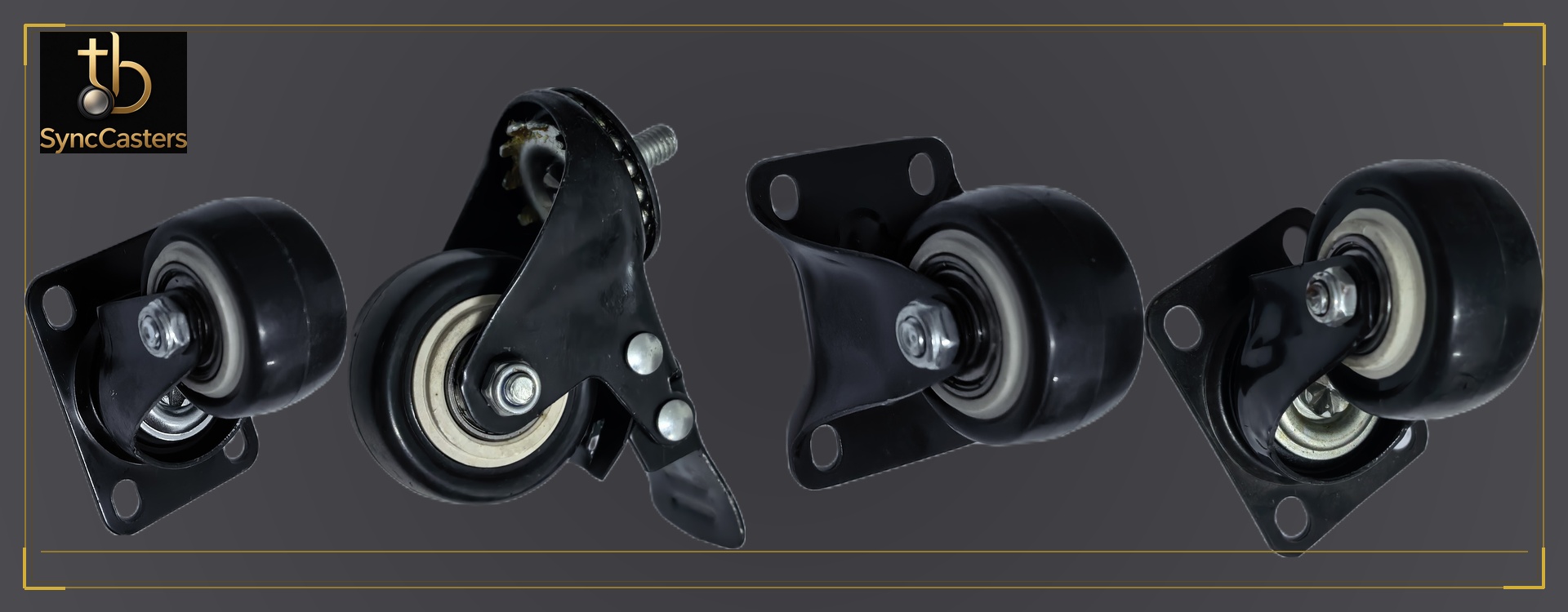
Bracket construction is covered in the same structured way. Swivel casters use ball-bearing or tapered-bearing swivel sections depending on load, so the wheel pivots under weight without slop. Rigid casters run straight and are usually paired with swivel units to form a two-swivel, two-rigid configuration that is stable to push and easy to steer. The catalog distinguishes top-plate mounting from stem, threaded-stem, grip-neck and socket fittings, and lists offset, crown height and bolt-hole patterns so the caster can be dropped onto an existing frame without redesign.
Brake options are documented as their own line. Total-lock brakes lock both swivel and wheel for a fully secured position; wheel-only brakes hold the roll but leave the swivel free; directional locks restrict the caster to a straight-ahead path for long conveyor-like runs. Buyers comparing a hospital cart against a foundry cart do not need the same brake, and the catalog makes that difference explicit rather than hiding it behind a generic 'with brake' label.
Specification tables give the numbers buyers actually read: wheel diameter, tread width, bearing type, bracket material, mounting dimensions, swivel radius, overall height, rated load per caster in both kilograms and pounds, and the recommended maximum load per set. Notes cover temperature range, floor compatibility and plating or finish. Where a series has variants, each variant gets its own row so that a 4-inch swivel with total-lock brake is not confused with a 5-inch rigid version of the same family.
The catalog also serves as the reference we quote against. When you send a part number from the catalog, our team knows exactly which bracket, wheel, brake and mount you mean, which removes the most common source of caster order errors: describing a wheel by size alone when the brake, swivel construction and mounting plate matter just as much. Distributors use the same document to build their own price lists and to train sales staff, and OEMs use it as the starting point for custom modifications.
How to Read a Caster Specification Table
post excerpt
How to Request or Customize Your Catalog
Requesting a standard SyncCasters catalog is straightforward. Contact us through the website, by email, or through your existing sales contact and tell us your role — distributor, OEM engineer, procurement, or end-user. We will send the latest PDF version of the catalog and, where it helps, a printed copy shipped with a sample order. The standard catalog covers our complete Light, Medium, Heavy and Extra-Heavy ranges with all wheel, bracket, brake and mounting variants in the current production list.
To send the most useful version, it helps if you tell us a little about your market. Which load tiers do your customers ask about most? What floors do you see — epoxy, tile, concrete, outdoor? Do you sell into food and pharmaceutical environments, industrial plants, or retail and hospitality? The more we know, the faster we can point you to the relevant series and the wheel materials that will actually sell in your region, instead of mailing you a document you have to filter yourself.
We also prepare customized catalogs for partners. For distributors and resellers, we can produce a version under your branding: your logo, your contact details, your part-numbering or cross-reference system, and a selection limited to the series that match your market. The technical data — dimensions, load ratings, wheel materials and brake types — stays the SyncCasters engineering data, so your customers receive accurate specifications while the document reads as your own product line. This is a common request from buyers who want catalogs that do not dump the entire factory range onto every customer.
For OEM and project buyers, a customized catalog can be narrowed to the families relevant to a specific application. A materials handling equipment manufacturer may only need the Heavy and Extra-Heavy swivel ranges with polyurethane treads and total-lock brakes; a furniture and display buyer may only need the Light and Medium series in nylon and TPR. We can assemble a focused document with your application on the cover, your approval notes in the margin, and the exact part numbers you are likely to order, which makes internal approval and procurement faster.
The catalog is only the starting point. Alongside the document, we can supply physical samples of the wheel compounds you are considering so your customers can feel the roll on their own floors, and we can produce dimensioned drawings for any bracket you intend to build into an existing product. Where the catalog does not list an exact match — unusual load, non-standard mount, special temperature — we treat that as a customization enquiry and come back with an engineering proposal rather than telling you to pick the closest item.
Because product ranges evolve, the catalog version is dated. When you receive an update, the changes are usually new wheel compounds, new brake configurations or revised load data, all of which can affect a selection you made earlier. We keep partners on the current revision so that quotes, price lists and web listings do not describe a bracket we no longer produce. If you have an older copy, ask us for the latest version before you place a large order.
A usable catalog reduces the cost of every sale downstream. Distributors spend less time on spec questions, engineers spend less time reversing dimensions from photographs, and procurement spends less time chasing samples that should have been selected from a table in the first place. We invest in the document because we know it is a tool our partners use every day — not a leave-behind that ends up in a drawer. That is why every series is shown to the same level of detail, and why the numbers are consistent across the PDF, our technical drawings and the parts that actually ship.








