
Casters Become Part of the Automated Platform
Automated guided vehicles and autonomous mobile robots do not just roll; they navigate, localize and repeat precise paths. The casters under an AGV or AMR are no longer commodity parts; they are engineered components that directly affect navigation accuracy, battery life and uptime. As the robot caster market grows rapidly, automated platforms demand wheels that are quiet, dimensionally consistent, low-resistance and compatible with the sensing systems the robot relies on. Getting these components right is what lets automation deliver on its promise of reliable, repeatable movement. Even small gains in rolling efficiency compound across a fleet of robots running double shifts every day.
Low Rolling Resistance and Consistent Height
AGV navigation depends on predictable motion. A caster with high or variable rolling resistance wastes battery and pushes the vehicle off its programmed path, while inconsistent mounting height causes the chassis to tilt and disturbs lidar and camera sensors. Purpose-built AGV casters therefore use precision bearings, low-resistance PU treads and tightly controlled mounting heights so the platform stays level and tracks accurately. Twin-wheel and swivel-stabilized designs prevent the wandering that simple single casters introduce on automated platforms. Even small variations in height or resistance accumulate over hundreds of trips, degrading navigation and shortening battery life.
Conductive and Anti-Static Wheels for Controlled Environments
In electronics manufacturing and explosive-atmosphere areas, static discharge is a real hazard, so automated platforms use conductive or anti-static caster wheels that bleed static safely to the floor. These specially formulated PU and nylon treads maintain controlled resistance over time, protecting sensitive components and meeting ESD requirements. Selecting the right conductive compound is part of automated caster engineering, not an afterthought, because the wrong tread can either build up static or short sensitive systems. As more automated lines handle electronics and pharmaceuticals, ESD-capable wheels are becoming a standard specification rather than a special order.
Encoder-Compatible Hubs and Magnetic-Guide Compatibility
Some automated platforms measure wheel rotation for odometry, which requires hubs compatible with encoders or couplings, while magnetic-tape and magnetic-guide navigation demands casters that do not interfere with the floor sensors. Motorized and in-wheel drive casters are emerging as integrated solutions that combine drive, braking and steering in one unit. As AMRs become more autonomous, the boundary between a caster and a powered mobility component is blurring, and buyers increasingly specify casters engineered to interface with the vehicle's control system. This integration is what allows automated platforms to localize precisely and repeat paths without drift.
Specifying Casters That Automate Reliably
Continuous-Duty Rating, Not Occasional Duty
An AGV runs for hours every day, so its casters must be rated for continuous duty rather than occasional movement. Bearings, treads and brackets must withstand thousands of kilometers with minimal wear, and the safety factor used for load calculation should reflect the nonstop cycle. The fast-growing robot caster market reflects a shift from generic wheels to components purpose-built for robotic duty, with load capacities engineered for continuous operation rather than human-pushed carts. Under-rating an AGV caster leads to early wheel wear, unpredictable tracking and unplanned stops that ripple through the whole automated schedule.
Floor Compatibility and Noise in Automated Zones
Automated vehicles often work alongside staff, so caster noise and floor protection matter. PU wheels protect epoxy floors and roll quietly, which is why they dominate AGV specification in warehouses and clean factories. Conductive compounds add the ESD control required in electronics zones. Because AMRs change direction frequently, swivel casters must turn smoothly without the chatter or stick-slip that would perturb navigation. The wheel compound is chosen to balance low resistance, quietness and floor safety, so the vehicle runs efficiently without disturbing people or surfaces. This is why vehicle builders now specify caster suppliers early in the design process rather than selecting wheels after the platform is complete.
From AGV Casters to Stationary Leveling for Cells
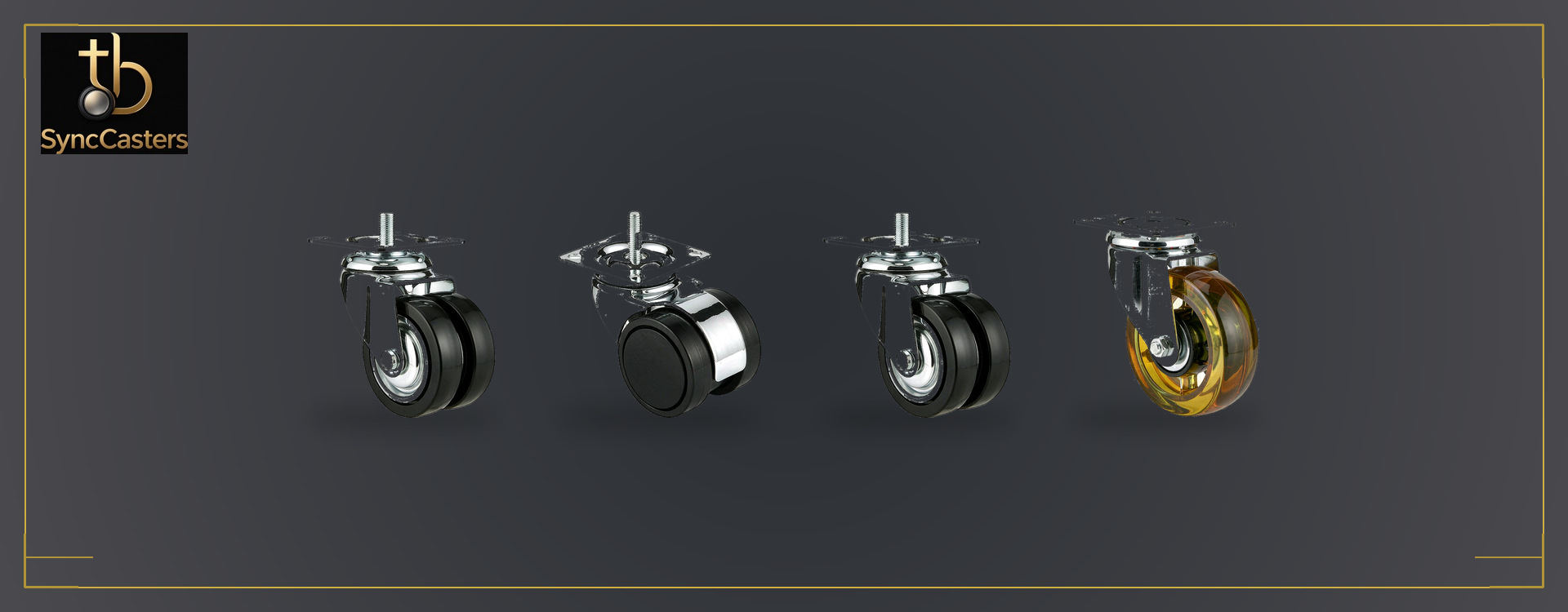
Even in highly automated environments, workcells need equipment that moves and then locks precisely. SyncCasters leveling casters support the stations around automated lines: in 1.5 to 2 inch light, 2.5 to 3 inch medium and 4 inch heavy sizes, they let operators position machine tools, workbenches and display fixtures, then screw the precision foot down to hold them level and still. Optional 30 mm and 60 mm spring-shock versions cushion sensitive machinery. While AGV casters keep the line moving, leveling casters keep the cells stable and precisely aligned with conveyors and robots.
SyncCasters for Automated and Industrial Mobility
SyncCasters supplies heavy and extra-heavy caster series, PU treads and engineered wheel solutions suited to automated platforms and continuous-duty equipment, with steel brackets, precision bearings and OEM or ODM support for custom mounting heights and materials. Our team works with equipment builders and automation integrators to match load capacity, tread compound, swivel behavior and floor compatibility to real vehicle duty cycles. Whether you are outfitting AGVs, AMRs or the stationary workstations around them, contact us to specify casters built for reliable, repeatable automated motion. As the robot caster market continues its rapid expansion, specifying wheels engineered for automation is no longer optional; it is the foundation of reliable, cost-effective automated operation.








