
Why Locking Technology Decides Safety
A caster that rolls perfectly is only half the design; the other half is the ability to stop it exactly where you want and hold it there. Brake and locking innovation has become a focus because automation and heavier equipment demand more reliable ways to keep carts, fixtures and machines stationary during loading, operation and operator work. The difference between a good brake and a weak one is measured in safety incidents, product damage and operator trust. As equipment gets heavier and lines move faster, the locking system has become as important as the wheel itself.
Side Locks, Total-Locks and Directional Locks
Image caption here



The simplest brake, the side lock, stops the wheel from rotating but leaves the swivel free, which is fine for light carts but allows unwanted turning under load. The total-lock brake stops both the wheel and the swivel at once, holding equipment completely fixed, and it is the standard for any cart that an operator works on while loaded. Directional locks do the opposite job: they lock the swivel to track straight, which keeps long trains of trolleys aligned down aisles. Modern designs integrate all three into robust, foot-operated pedals that survive thousands of cycles without slipping or releasing unexpectedly. Choosing the right lock type is therefore a safety decision, not a cost one.
Integrated Leveling-Foot Locking on Leveling Casters
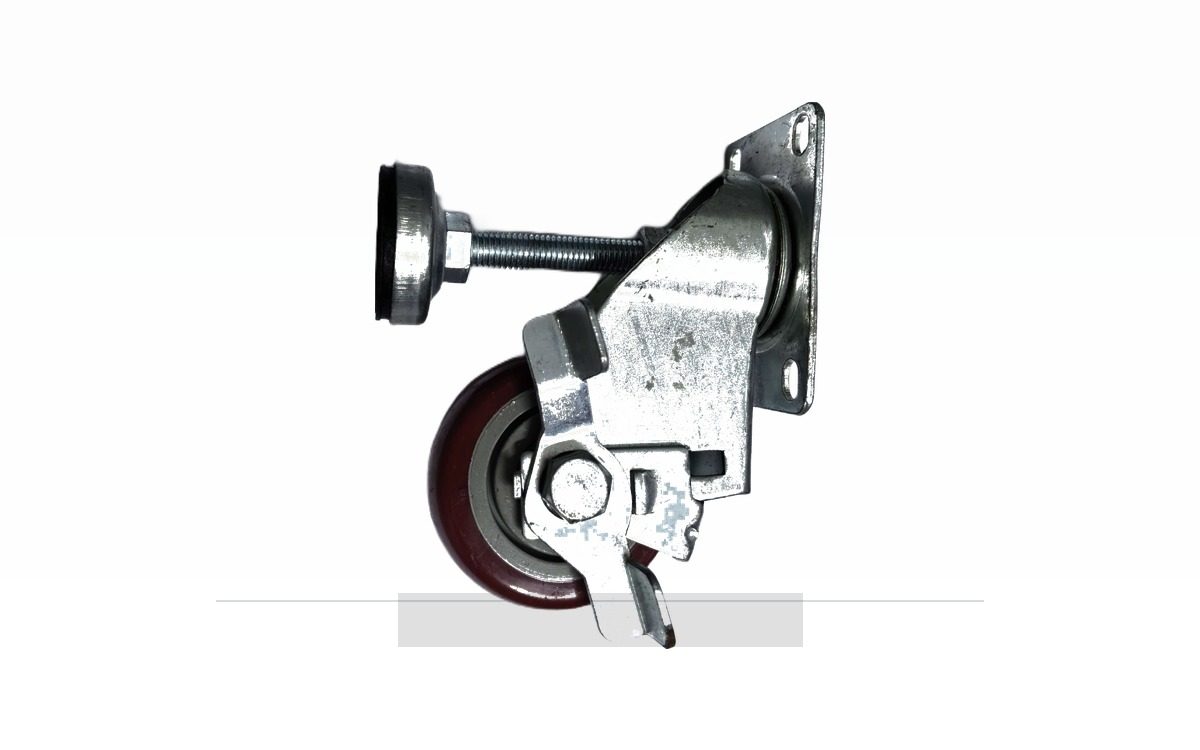
The most important locking innovation for stationary equipment is the integration of the leveling foot. On a leveling caster, the operator moves the equipment into position, then screws the precision threaded foot down until it takes the weight off the wheel and locks the unit level. This is not a brake in the traditional sense, but it is the most secure way to hold a machine still: once the foot engages, there is no rolling at all, regardless of brake wear. This dual function is why leveling casters have become essential for machine tools, display racks and workbenches that must be perfectly level during operation. It also removes the risk of a brake gradually slipping under a heavy, vibrating machine.
Pedal Ergonomics and Predictable Release
Locking mechanisms are only safe if operators actually use them, so modern brake design emphasizes ergonomics. Wide, high-contrast foot pedals that lock and release with a single foot motion reduce the temptation to skip the brake. Predictable release, positive feedback and corrosion-resistant pivot points all contribute to a brake that operators trust. For equipment that locks and unlocks every shift, such as modular workstations and line-side fixtures, brake durability under repeated use is as important as holding strength. A brake that is awkward to reach or stiff to press will simply be ignored, which defeats the whole safety purpose.
Specifying Brakes for Safe, Stationary Operation
Matching Brake Type to How Equipment Is Used
Choose the brake by function, not by price. If the equipment only needs to stop rolling on flat floors, a side lock may suffice. If an operator loads, assembles or works on the equipment while it stands, a total-lock brake that secures both rotation and swivel is the safe choice. If the equipment must track straight down long aisles, add a directional lock. For machines that operate while positioned and cannot tolerate any settling, the securest solution is a leveling foot that lifts the wheels off the floor entirely rather than relying on brake friction alone. This function-first approach prevents the common mistake of under-specifying brakes on equipment that actually needs to stay put.
Holding Under Load and on Slopes
A brake that holds an empty cart may fail under a fully loaded one, which is why brake rating must be checked against the actual loaded weight. Brakes are friction devices, and friction limits the load they can hold on inclined or sloped floors. On ramps, dock plates or sloped concrete, equipment should additionally be chocked or supported by leveling feet. Engineers should verify that the brake mechanism and bracket are rated for the dynamic loads of starting and stopping, not just static weight, because repeated impacts loosen weak brakes over time. Under-specifying here is a genuine safety hazard rather than a minor inconvenience.
Leveling Casters: The Ultimate Stationary Solution
SyncCasters leveling casters combine mobility with the strongest form of stationary locking available. Available in 1.5 to 2 inch light, 2.5 to 3 inch medium and 4 inch heavy sizes, each unit uses a precision threaded leveling foot that transfers the load from the wheel to the foot, eliminating all rolling once engaged. Optional 30 mm and 60 mm spring-shock versions absorb vibration for sensitive machinery. Applications range from machine tools and packaging equipment to display racks, workbenches and industrial devices that must sit perfectly level and still while working. The result is equipment that rolls when needed and cannot drift when it should not.
SyncCasters Brake and Leveling Solutions
SyncCasters supplies reliable foot-operated brakes, total-lock mechanisms and integrated leveling-foot casters engineered for safe, repeatable stationary operation. Every brake is tested for cycle life and holding strength, and our steel brackets are built to resist the impacts that loosen weak hardware over time. With OEM and ODM customization for pedal type, bracket finish and foot adjustment range, our team helps you specify the right locking solution for carts, fixtures and machines that must move easily and stand firmly. Contact us with your equipment weight and how it is used, and we will build a safe, dependable mobility and leveling system.








