
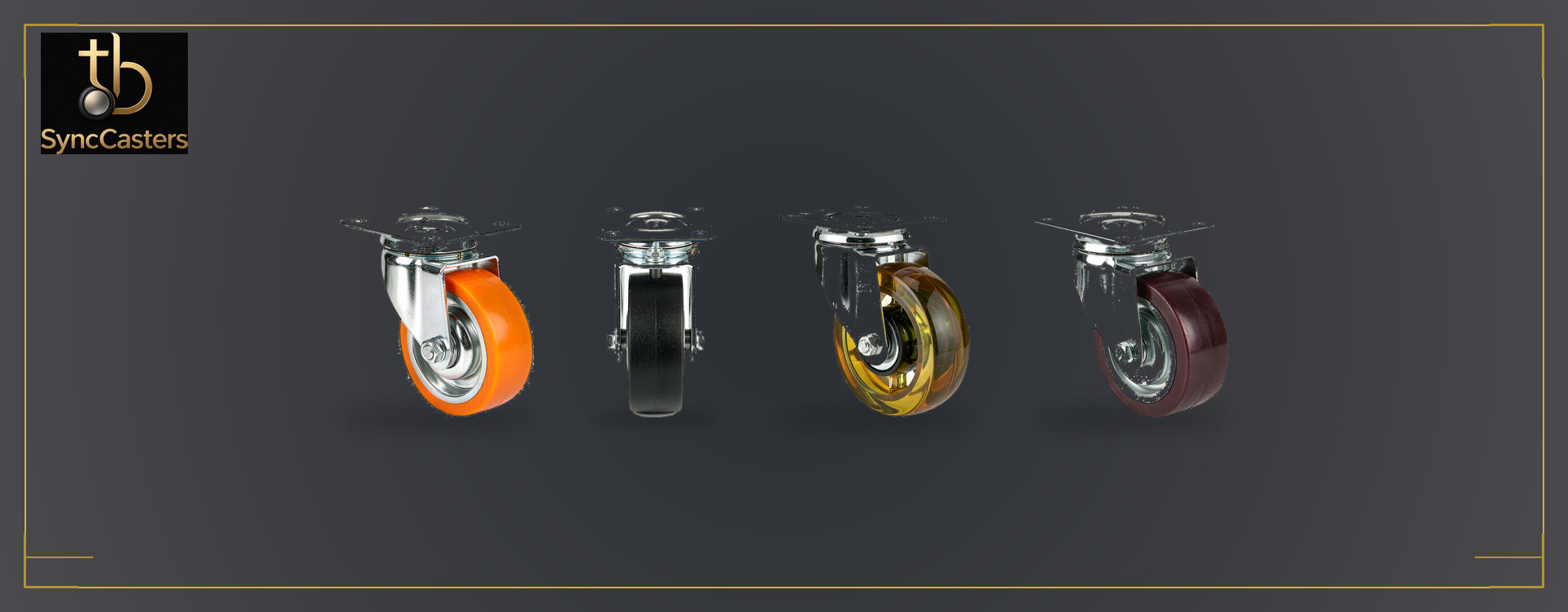
Wheel Material Decides Performance
Every caster specification starts with one question: what is the wheel made of? The material determines how much the caster can carry, how well it protects the floor, how noisy it is and how long it lasts in a given environment. This comparison covers the five most common industrial wheel materials and where each one performs best.
Polyurethane (PU): The Balanced All-Rounder
Polyurethane wheels deliver the best overall combination of load capacity, floor protection and rolling ease. They carry medium to heavy loads without marking finished floors, absorb shock better than hard plastics and roll quietly. PU wheels resist oil and many chemicals, and they perform well on smooth indoor surfaces from epoxy to tile. In industrial and institutional environments, polyurethane now accounts for roughly 35 to 40 percent of unit usage, reflecting its versatility. The main trade-off is cost: PU wheels are more expensive than basic plastic wheels, but their longer life usually pays for the difference in demanding applications.
Nylon: Maximum Load on Smooth Floors
Nylon wheels carry very heavy loads for their size and resist wear, chemicals and corrosion. They are an excellent choice for high-capacity equipment on smooth concrete where floor marking is acceptable. The trade-offs are real: nylon is hard, so it generates more noise than resilient materials, and it can mark or scuff softer floors. Nylon wheels also transmit more vibration to the equipment, which matters for sensitive loads. Best use: heavy industrial carts, dies and mold transport, and automated platforms on good floors.
TPR and Rubber: Quiet and Floor-Friendly
Thermoplastic rubber (TPR) wheels are quiet, shock-absorbing and gentle on floors, making them the standard for silent casters in medical, hospitality and office environments. TPR performs well on smooth indoor surfaces and is available with steel or PP cores to increase load capacity. Rubber wheels add further cushioning and grip, with good performance on slightly rougher surfaces, though rubber generally carries less load than PU of the same size and can degrade in some chemicals and sunlight. Best use: hospital equipment, serving trolleys, office furniture and any application where noise and floor protection matter more than maximum load.
Polypropylene (PP): Light Duty and Chemical Resistance
Polypropylene wheels are light, economical and highly resistant to water, chemicals and corrosion, which makes them popular for food service, washdown areas and light-to-medium industrial duty. PP wheels roll easily and are available in steel-core versions for higher capacity. Their hardness means moderate noise, and they are not the first choice for soft or polished floors. Best use: food carts, bakery racks, chemical environments and general light-duty equipment where economy and hygiene matter.
How to Match Material to Application
Start with load and floor, then add environment. For heavy loads on smooth concrete, nylon or steel-core PU. For heavy loads with floor protection, PU. For quiet movement on finished floors, TPR. For wet or chemical environments, PP with corrosion-resistant brackets. For extreme duty such as foundries, cast iron. When in doubt, PU is the safest general-purpose choice across most industrial and institutional applications. Once the material is chosen, verify that the wheel hardness and core design match the actual load and duty cycle.
SyncCasters Wheel Range
SyncCasters offers the full spectrum of caster wheel materials: diamond-series and PP wheels for light duty, TPR silent casters for quiet applications, rubber and gray-rubber series for cushioned movement, PU and nylon options for medium and heavy duty, and steel-core heavy and extra-heavy series for maximum loads. Every material is available with the matching bracket, brake and mounting configuration. Our team can help you compare materials against your floor, load and environment, and specify the wheel that delivers the best life-cycle value for your application.








